Sleepy Hollow

May 15, 2008

Bizarre worm’s eye view of riot.

I watched a fuzzy off-air recording of THE LAWLESS the other day, which is possibly the weakest of Losey’s American features. But they’re an interesting batch. U.S. Losey is hard to see and often underestimated, but there’s plenty to admire:

First off, Losey made a number of short films, several of them corporate promos. Despite his communist sympathies, he was apparently happy to whore himself out to big business. Well, the man had to eat. And drink. Especially drink. I haven’t seen any of these shorts and Christ knows if I’ll ever get to. PETE-ROLEUM AND HIS COUSINS sure sounds enticing. Would make a good support film for ROCCO AND HIS BROTHERS, I bet. Programmers, take note!

The Boy Who Didn't Turn Yellow

THE BOY WITH GREEN HAIR, commissioned by liberal producer Dore Schary, is a middlebrow liberal anti-war tract made cherishable by the fact that it’s completely insane from beginning to end. Howard Hughes, who bought R.K.O. midway through the film’s production, did his best to strangle the pacifist message, but Losey, Schary, screenwriters Alfred Lewis Levitt and Ben Barzman (soon to join Losey on the blacklist), and child star Dean Stockwell all resisted Hughes’ interference in their own ways, and what made it to the screen is fairly uncompromising, and completely bananas. A boy’s hair turns green overnight after he learns that he’s a war orphan. The ghosts of the slain instruct him to keep his verdant locks as a warning against the horrors of armed conflict. Wow.

Heavy irony.

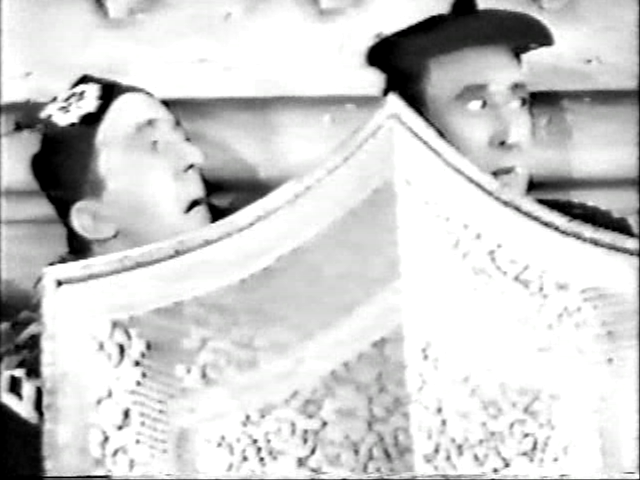
THE LAWLESS. Another liberal message film, this one about lynch mob violence, it’s but devoid of GREEN HAIR’s agreeable barminess. The best idea is naming the Mexican ghetto Sleepy Hollow, and restaging the Headless Horseman bridge chase with an ice cream van and a pursuing police car. Otherwise, comparison with Fritz Lang’s FURY is instructive. The studio prevented Lang from having a black protagonist, but at least Lang’s story places the victim front-and-centre in the narrative, and challenges our easy perceptions by turning him from persecuted into the persecutor partway through.

Losey is allowed to use actual minorities, Mexicans, in his story, but the hero is a white newspaperman with less at stake in the story. It’s like a version of TO KILL A MOCKINGBIRD with the child’s-eye view removed, and with no real tragic injustice to get angry about.

Stranger on the Prowl

THE PROWLER is knockout. A lucid and lurid skewering of “wrong values” in capitalist society, in the form of a tight noir potboiler. Losey was pleased with his integration of production design and camera movement / composition: his collaboration with designer Richard MacDonald would be a defining feature of his films in exile. Manny Farber, who sometimes reacted against Losey’s editiorialising, admired this one. “Socially sharp on stray and hitherto untouched items like motels, athletic nostalgia, the impact of nouveau riche furnishings on an ambitious ne’er-do-well, the potentially explosive boredom of the childless, uneducated, well-to-do housewife with too much time on her hands.”

M. Butterfly

M. Losey’s remake of the Lang classic has terrific scenes, and uses some of its borrowings well — others get in the way. Some of the script is fairly dumb, but Losey’s use of L.A. locations, including the iconic Bradbury Building, makes it fly. I blogged it HERE.

THE BIG NIGHT is possibly best of all. I blogged about it HERE, and in the weeks since then it’s stayed in my mind and grown clearer and sharper. It’s the least strident of Losey’s early message films, and it disguises any tendency to preach with a grotesque and surreal surface. Peak noir.

Losey was clearly on a roll. Despite M being shot in only 20 days, and THE PROWLER in 17, both are vigorous, dynamic and intelligently shot genre pieces. Losey could find interesting things to say within the constraints of the thriller, and put his points over in an economical and entertaining manner.

Forced to work abroad by the blacklist, Losey would find himself working within entirely different genres and constraints. The British film scene is a very odd world…

These are the damp


What a gyp!

May 14, 2008

Joseph Losey characterised the screenplay of THE GYPSY AND THE GENTLEMAN as “immoral, vicious, déjà vu, old fashioned and badly constructed.”

To take these charges one at a time:

1) Immoral.

While, like most films in the bawdy / historical romp / bodice-ripping genre, TGATG bounces along on (very mildly) saucy bedroom and bathroom scenes and moments of violent passion, the real immorality is in the attitude to gypsies, who are all pretty fiendish. Admittedly, Melina Mercouri, as Belle, the femme fatale, is only half gypsy, but even she despises her kind. On the other hand, Losey’s decision to portray Belle without any redeeming features breathes a bit of much-needed life into the yarn.

2) Vicious.

There’s a streak of nastiness in this genre, emerging in scenes like the hunt in TOM JONES and the whip fight in both versions of THE WICKED LADY. Michael Winner’s ’80s remake stands as possibly the most obnoxious film of this kind. Poor Marina Sirtis (from STAR TREK: TNG) is required to be naked in every single scene she appears in, and get bullwhipped by Faye Dunaway in front of guffawing peasants (I can understand some people enjoying the spectacle of a whipping, but is it actually FUNNY?). Losey’s film is not that vicious, but the plot is driven by acts of cruelty — it could almost play as a Hammer horror if Losey relished the sadism instead of pulling back on it.

3) Déjà vu.

Well, the movie is certainly intended to remind us of the popular Gainsborough Films of the ’30s and ’40s. Rank Studios, under the control of John Davis (”the man who killed the British film industry, caricatured as Don Jarvis in PEEPING TOM) was largely bereft of new ideas and sought to recapture former glories by, well, carrying on exactly as before.

4) Old fashioned.

That kind of goes with point 3, doesn’t it? Losey tries to enliven the film and set the action within an interesting world. He smuggled production designer Richard MacDonald onto the film — MacDonald was Losey’s regular collaborator, before and after, but lacked a union card, so had to work anonymously at this stage.

(Union cards were very hard to get. My friend Lawrie tells of being approached by friends who wanted him to sign some papers to get a young tyro director named Michael Winner into the union. “And I remembered how hard it was for me to get my membership, so I signed his papers. I didn’t know him from Adam. And it wasn’t until some years later that I suddenly thought, ‘My God, what have I done?’”)

MacDonald’s work is very grand, and Losey at least had a reasonable budget and schedule for once, but he was up against the rigid infrastructure of Davis’ Rank. The music score was imposed on the film and Losey had little or no say in the editing (it’s marked very sloppy continuity cutting, quite unlike the sharp and surprising cuts of SLEEPING TIGER, earlier, or KING AND COUNTRY, later).

5) Badly constructed.

Is it ever! This is the biggest problem, because it has nothing to do with taste, like the other problems, and everything to do with basic narrative economy and good storytelling (and this is, after all, a YARN, not some mood piece). The film takes AGES to get going, devoting endless scenes to setting up characters (some of whom, like Flora Robson’s famous actress) aren’t even necessary, and all of whom could have been introduced IN ACTION.

(Screenwriter Janet Green has some stronger credits: she co-scripted VICTIM, SAPPHIRE, and SEVEN WOMEN, an impressive batch.)

As a result, the first half of the film is set-up. Once the plot actually starts (45 minutes in!) things get quite a bit more interesting. Debt-ridden Keith Michel, having married the mercurial Mercouri, is tempted into a scheme to cheat his sister of an inheritance. We’re in passable film noir territory here. In fact, with Mercouri entering the household, taking it over, and then bringing in her lover as a servant, we’re following the exact path of THE SERVANT, Losey’s later triumph. But that simple plotline is here gussied up with a lot of frippery and whatnot — as Dorothy Parker once complained, “This isn’t just plain awful: this is fancy.”

However, the plot, once in motion, carries us along for a while, before collapsing to its knees under the burden of too many contrived reversals. Then a spectacular carriage crash (one stuntman seems to bounce nastily off a stone balustrade) brings things to a rather impressive conclusion, with a combined kiss/murder/suicide, and a major bad guy escaping unpunished (amazing the censors permitted THAT). So it’s by no means all bad.

Losey’s gift for casting helps. Although Keith Michel can do little save jut his telephone receiver of a jaw, Mercouri looks better than usual with dark hair for once, and grins maniacally to suggest any given emotion. You can’t take your eyes off her, for fear she’ll get you. In small roles we get a surprisingly muscular Nigel Green, tiny Welsh pulp Mervyn Johns (Losey alone seems to have discerned a potential for creepy wickedness in the timorous gnome-fellow), and best of all, as Mercouri’s true love, the sloping madman that is Patrick McGoohan. When Mercouri and McGoohan are on screen together, essaying their various accents (she trying in vain to suppress her Greek, he forcing a sort of Mummerset-Oirish upon us), you often can’t understand one word in ten, but that word is usually “Poo!” or “Arr!”, which speaks volumes.

(Losey rang Jules Dassin to ask how he could contact Mercouri. “Well, curiously enough, she is right here beside me in bed.” Her Greek skin was considered sub-standard for a British production, but Losey’s doctor treated the Melina melanosis [or whatever the hell the problem was] and she got the all-clear.)

After TGATG was released, Rank terminated Losey’s three-film contract, leaving him high and dry. He described the British film industry as “going to Hell on wheels … Subjects are generally conventional and unimaginative with many taboos.” In his next film, Losey came up against one of these taboos, the insistence that the British police force, like the army, must always be shown as above corruption…


Quote of the Day: My bloody head

May 14, 2008

Joesph Losey’s FIGURES IN A LANDSCAPE…

Chopper

After being harried at close quarters by a sinister C.I.A.-style black helicopter, Robert Shaw is obsessed by thoughts of DECAPITATION:

“I didn’t know he could do that. I didn’t know anybody could. He could have taken my head off. I could have been running around like a bloody chicken with my head bouncing up on the ground in front of me!”

The Helicopter Spies

Later:

“I might have tripped over it.”

“What?”

“My head. Could have scored a bloody goal with it. I’d like to kick my bloody head right up into his perspex.” 

Whirlybird

The film is stunningly photographed (three D.O.P.s, including the great Alekan), well acted of course (only Shaw and Malcolm McDowell have speaking parts) and has the kind of weird theatrical dialogue Losey liked, this time written by Shaw himself — Shaw was a successful but far from prolific playwright.

Comparisons with Jansco seem apt: abstract political cruelty in a vast landscape. It’s also a bit like the action movie Pinter never wrote. And while Losey doesn’t go in for Jansco-esque sequence shots, he does use longer takes than are standard in a two-fisted tale. Particularly stunning are the headlong plunges from the helicopter’s POV, filmed with a wide-angle lens that makes the scenery rush at us like a bunch of riotous golems and ents. This means that Objects in Camera are Closer than they Appear, which is a terrifying thought when you see how close they APPEAR. The scene of Shaw’s up-close persecution by the chopper is staggering, unheard-of: Losey appears to have a desire to push stunt-work to extremes, as the carriage crash at the end of THE GYPSY AND THE GENTLEMAN also suggests. Here it’s Shaw himself for at least most of the action, getting his as kicked by a large piece of flying machinery that has the ability to mince him up good if it changes angle at the wrong time.

It wouldn’t be me!

The Flyer


That’s what I’m talking about…

May 13, 2008

Ein Klein Nachtmusik

The Joseph Losey Collection– out in September on Region 2 DVD in the UK.

Contains THE CRIMINAL, which looks sensational, crucial stuff like THE SERVANT, THE GO-BETWEEN and ACCIDENT, also EVA, SLEEPING TIGER and, surprisingly and delightfully, M. KLEIN.

Trailer for THE CRIMINAL. I dig how the voice-over man is incredibly ANNOYING. Not his voice, his whole ATTITUDE. If you met this voice-over man at a party you’d be compelled to glass him in about fifteen seconds, he’s that offensive.

Losey’s second film with Stanley Baker, THE CRIMINAL looks to me like a gutsy piece of work. His first film with Baker, BLIND DATE, like his first film with Dirk Bogarde, is more of a rough sketch for what’s to come. But still fascinating. Perhaps perversely, of all the Losey’s I’ve still got to see, THE CRIMINAL is the one I’m most excited about.

Alas, I won’t have this beauty in my hands until long after J.L. Week is over, but maybe we’ll have a second week in September — if Fiona can bear it.


The Intimate Finger

May 13, 2008

Bright Eyes

Not really, of course. Joseph Losey’s pseudonymously-directed 1956 mystery was released as THE INTIMATE STRANGER (great title, and apt!) in the UK, and FINGER OF GUILT (sappy, generic title) in the US. So I’ve simply combined the two titles into one SUPER-TITLE. Richard Basehart plays the titular finger.

For its blacklisted director (working as “Joseph Walton” in the UK version, using producer Alec C Snowden as a front for the US release) and writer (the celebrated Howard Koch, writing as “Peter Howard”) it was a payday and a chance to establish themselves in the UK film industry. Koch dismissed the result as entirely undistinguished, but it led to better things.

I’d never taken notice of Richard Basehart much before except in IL BIDONE, where he’s dubbed. Here it was a shock to hear him sounding like John Huston — since Basehart played Ishmael in Huston’s MOBY DICK the same year, I’m assuming this is a deliberate impersonation, decades before Daniel Day-Lewis made off with Huston’s gravelly purr for THERE WILL BE BLOOD.

One thing that’s fascinated me about all the Losey films I’ve run recently is the element of autobiography. From Michael Redgrave’s alcoholism in TIME WITHOUT PITY to the tortured father-son relations in THE BIG NIGHT, each Losey film seems to declare some personal significance. Most blatantly of all, FINGER-STRANGER deals with a blacklisted filmmaker driven out of the US and targeted by a conspiracy in a British studio. The atmosphere of paranoia and persecution must have been something both Losey and Koch could relate to.

STRANGER-FINGER begins with an eye examination, the bright light being something which will return at the climax:

Bright Light!

At the start.

Lights! Cameras! Action!

And at the end.

Basehart begins to tell his life story and we delve into flashback, and eventually wonder “Hang on, why is he sharing all this guff with his OPTICIAN?” then we realise that the eye-man must actually be a head-shrinker only the film just kinda forgot to mention it. The framing structure is wholly unnecessary anyway, but as with Losey’s earlier THE SLEEPING TIGER, it takes us back to that innocent ’50s faith in psycho-analysis — a lot of the lefties who got drummed out of Ho’wood had the same trust in Freud they showed in Stalin, but then Freud was huge all over tinseltown, where the Big Lie is what business is founded on, and all the couch-space in town is eaten up by rich fruit-loops.

The story gimmick — young exec is tormented by mysterious letters, recalls the opening of Altman’s THE PLAYER, but this one develops differently: a young woman writes to Basehart and his wife (daughter of studio boss Roger Livesey) claiming to have had an affair with Basehart. He has no memory of her, yet she’s insistent, and seems sincere.

Alas, the first half is quite unbelievably stately, with the editor lingering on every scene after the protagonist has left. Maybe the movie was too short? Losey’s filming is fluid, but rarely provides the flash of Hollywood excitement he brought to the best bits of SLEEPING TIGER.

I am smoking a fag

All that holds the attention during this opening trundle is the central question — who the hell is this girl and what is she all about? — OK, two questions — plus some spectacularly inappropriate and loud stock music. All early British Losey films seem to feature scenes where women put on loud records then attempt to talk. At times the score here is effective, as it must be: if you play tender moments with CRIME JAZZ and suspense bits with Liberace schmaltz, it WILL WORK at times, and when it does it’ll be better than if you did it the sane way round. Half the time here it doesn’t work at all, and drunkenly pulls you out of the film, but there’s one romantic clinch where the timpani freak-out accompaniment fairly gets your pulse going and you think, “Golly, THIS IS CINEMA!” for maybe the only time.

So, the police attempt to cherchez la femme fatale, but she keeps her cool and doesn’t change her story, and they wind up doubting Basehart. For a moment it looks like her long recitation of her imaginary past life with Basehart is going to lead into a flashback, which would give us a flashback within a flashback within an opticians, but she cuts it short and saves us the detour.

Stranger of Guilt

There’s a heavy spoiler alert now, because if I give away the ending then there’s no real reason to see this underwhelming effort, which might be a good thing, but it’s your choice, OK?

Basehart finds out that the whole thing was a set-up. His boss’s assistant, played by diminutive Welsh house-elf Mervyn Johns, resenting Basehart’s ascendancy, has hired an actress to destroy his life. That’s studio politics for you.There’s a tiresome false ending where Basehart thinks Livesey was behind the frame-up, then Johns gives himself away by repeating the whole plot in a dubbing booth with the mic on and broadcasting his (finger of) guilt to the whole sound stage — oops! Then Basehart persecutes his nemesis with an arc light (like all Celts, he instinctively fears bright illumination) before clubbing him to the studio floor with his powerful Richard Basehart fists. Regrettably, a climax where a muscular young man beats up an elderly, out of shape guy half his height into a tiny, defenseless Welsh pulp is not exactly a nail-biting suspenser.

Johns

Shadowplay!

Now the film pauses yet again to admire sultry Mary Murphy (from THE WILD ONE), who has been enticingly cool throughout, then reunites Basehart with his estranged wife, who somehow got the news he’s innocent before anybody else knew.

Not a great film, but a great central enigma, and the blacklisting angle (not explicitly political — Basehart had a fling with a studio boss’s wife) is enticing. At the end, Basehart furiously calls Johns “an informer”, and the rage in that scene feels… personal.

Losey

The producers would like to thank Fiona Watson for the phrase “tiny, defenseless Welsh pulp.”


Jazz Crimes!

May 12, 2008

Below, see Dirk on the dance-floor in Losey’s SLEEPING TIGER. I think Losey was a bit of a jazz buff and the scenes in “The Metro” club in this film are among the most exciting — although, this being a sort of juvie delinquent flick, jazz and interracial leisure activities are given something of a taboo edge, seen as DANGEROUS, although obviously more exciting than the domestic goings on chez Alexander Knox.

All of which makes it nicely perverse and subversive – keywords for Losey.

I love the glide past the horn player, round and back, that starts this scene.


Sleeping Tiger, Crouching Dirk

May 12, 2008

“Must be hard getting servants these days,” muses Dirk Bogarde -

- before tripping the poor skivvy and sending her crashing to the floor amid crockery and glassware -

- and leering over her misfortune in sexual fashion…

THE SLEEPING TIGER is a somewhat eggy juvie delinquent melodrama made by Joseph Losey, recently blacklisted in Hollywood and now using producer Victor Hanbury as a front – while no blacklist applied in England, it was thought wise for blacklistees to work pseudonymously to avoid any problems with American distribution. Within a few years Losey would be working openly under his own name, but he would never film in the States again.

Joe and Dirk both reported;y thought this film was sheer hocum, but got on well and saw each other’s potential, resolving to work together again on something worthwhile. THE SERVANT in 1963 would give them that opportunity in spades. Dirk plays Frank Clemmons, a troubled young criminal taken in by psychiatrist Dr. Clive Esmond, played with unbridled lassitude by Alexander Knox. Knox, a Canadian who worked in Hollywood before settling in Scotland, would soon play another woolly liberal for Losey in THESE ARE THE DAMNED.

Inspector Hugh Griffiths of the Yard casts a beady eye over some dodgy Joan Miro.

Mrs Esmond, token yank Alexis Smith, is soon smitten with the arrogant D.B. Catching him bullying the servant, she blazes, “I wish I were a man!” before snogging him violently. It would be ungentlemanly of me to suggest that the feeling was mutual.

Losey puts far more into this film than into his next British time-waster, FINGER OF GUILT / THE INTIMATE STRANGER. Although much of the film passes in short, montage-like sequences devoid of any tension or dramatic gristle, whenever there’s a longer scene of interpersonal conflict, he pulls the stops out and goes for maximum sizzle. Extreme angles and sinuous camera moves provide nicely modulated variation between snapping whipcracks and seductive oozings of emotion. The seeds of THE SERVANT are sewn. The film actually aspires to the theatrical, and through it reaches the cinematic, in fits and starts. There are genuine flickers of that Pinter Wonderland of menace and powerplay, often stifled at birth by the rather inane script. Every fade-out feels like a betrayal.

Since Dirk is committing robberies while under Doc Knox’s care, AND cheating with the Doc’s wife, we can’t help but feel that the liberal head-shrinker is a bit of a sap. Which leaves the film without a point, unless it’s a right-wing Daily Mail type point, since Dirk should clearly be in jail, Knox should be struck off, and Smith should take a cold shower.

“One day we should run up to Scotland,” suggests Knox, who lived there. Bogarde, who endured an unhappy childhood in Glasgow, makes a sour face.

Losey goes mad in the jazz cellar scenes, just loving it, daddy-O, and here we see what a really inventive director he is: the same dynamic style showcased in the scenes of domestic conflict, but sexed up with music and mood lighting and eroticism and WOW!

Far from being a second feature, SLEEPING T unites Losey with the editor of THE RED SHOES, the future composer of BRIDGE ON THE RIVER KWAI and cinematographer Harry Waxman (THE WICKER MAN) all of whom acquit themselves admirably, when the sketchy plot allows them space to do so. Harry Waxman’s photography of nocturnal London streets is particularly fine, and Losey has him try even more trick mirror shots than are found in THE SERVANT.

I keep trashing the script, which is by blacklistees Harold Buchman and Carl Foreman, but as Gavin Lambert wrote, “There is a splendour about this film, which has one of the most absurdly extravagant plots on record, and never flinches from it.” Which shows that Lambert was way ahead of the curve as far as appreciating Losey in the UK. I just wish the film (which is a pretty nippy 89 mins) allowed the psychodrama time to build, while avoiding all the scrappy little scenes of fishing and horse-riding which do nothing for the plot (and really, how could they?).

Then, unexpectedly, the shrink has a Dirk breakthrough and our juvie is cured, alright. Several minutes of desperate vamping ensue as the plot seems to be over, then Dirk announces he wants to go to jail to pay his debt to society, but it’s really to escape the doc’s clingy wife, and now suddenly SHE’S the psycho one, and it all ends in a high-speed car chase with a thrilling syncopated jazz fusion abstract montage smash-up into a symbolic tiger billboard!

Moral: women are evil.


Notice is given –

May 12, 2008

– that this is

JOSEPH LOSEY

WEEK –

– at Shadowplay.

In fact, it’s Joseph Losey Week all over the whole internet, though naturally we’re keeping it quiet and low-key. This is the only site that’s doing it OVERTLY.

We hope you enjoy!

Watch this space!


“Yes, that’s the only bit of England they got.”

May 11, 2008

Over at the marvellously wide-ranging and thoroughly smart blog Observations On Film Art and “Film Art”, run by David Bordwell and Kristin Thompson, there’s just been a fascinating postby K.T. It deals with Alberto Cavalcanti’s wartime British propaganda film, WENT THE DAY WELL? which I’ve always found to be a rich and provocative film. Thompson’s post is very welcome because Cavalcanti’s film, like a lot of Ealing Studios’ output, is better known in the UK than abroad, and it deserves to be celebrated more widely. I heartily second Thompson’s suggestion that the Criterion Collection should release the film.

Nevertheless, I felt compelled to add my own two cents, because I think Thompson’s description of the film only touches on part of why it’s so interesting. You should read her excellent summary of it first, which gives a good sense of the film’s charm and excitement. [She has now responded to this post at the foot of her post, so you can read where she agrees and disagrees with the following.]

(Capsule version for the lazy: German fifth columnists infiltrate a proverbially sleepy English village and take it over, but are defeated when the villagers turn on them.)

BUT — WENT THE DAY WELL? is a very peculiar piece of work. Nearly everything in it works on at least two levels, often with contradictory meanings. Thus, the introductory scenes, in which as Thompson rightly says, the villagers ”innocently cooperate in typical British fashion, giving directions and offering tea and spare bedrooms,” also serve a straight propaganda purpose, as a warning to audiences not to be so trusting. Nearly all the behaviour we see at the start of the film is marked by casualness, carelessness, and a lack of awareness that there’s a war on. Nevertheless, the villagers are charming and quirky and appealing. The scenes entertain with light comedy, set up the major characters, build tension and dramatic irony based on our foreknowledge of the German plot, and also serve as a wake-up call to the home front.

Once the action starts, with surprising ruthlessness, the film becomes more subversive. According to Cavalcanti, a pacifist, his objective was to show that when war comes to even a place as charming as Bramley End, the people become monsters. Without the slightest change in underlying personality, peace-loving and jocular countryfolk pick up weapons and set about slaughtering their fellow humans.

Of course, since Cavalcanti had been commissioned to make the film to help the war effort, and also as a piece of commercial entertainment, he had to disguise his message. So, as Thompson notes, when the villagers realise the danger they face, “they come through with English pluck and resourcefulness – the women as well as the men,” and yet Cavalcanti allows us to read the action scenes another way.

The cheerful, stiff-upper lip approach of the characters (most of them played by much-loved character actors like Harry Fowler  and Thora Hird) can seem pretty callous. “Can’t even hit a sitting Jerry,” Hird scolds herself, after failing to kill an opponent from a distance with her rifle. The suggestion that even within the gentlest country lady or village postmistress there lurks a savage killer is what gives the film an extra twist. Cavalcanti spoke of this intent long after the fact, and there’s no reason to think he was playing up to pacifist critics — the deep ambivalence and disgust at violence is all there in the film, as are the conflicted feelings provoked by the sheer evil of the Nazi threat.

All of the combat is presented in insistently domestic or rustic settings, using household objects like a pepper pot and an axe for firewood as weapons. The sight of hand grenades skittering across the floorboards of an English country manor is an arresting one. And the massacre of the Home Guard (a defensive unit composed of men unfit for normal service, and nicknamed “Dad’s Army” during the war) occurs on a sunlit and leafy country road…

England made me

As Thompson explains in detail, Cavalcanti’s career was a strange and complicated one — he directed in France, Britain and Brazil. Like my friend Travis Reeves, he moved from production design (Marcel L’Herbier’s L’INHUMAINE) to sound design (the classic documentary short NIGHT MAIL, in which music by Benjamin Britten and poetry by W.H. Auden are synchronised to the sounds of a chugging steam train.)

By no means all of his work is as interesting as WTDW. Ealing Studios lumbered him with CHAMPAGNE CHARLIE and NICHOLAS NICKLEBY, neither of which he seem to have inspired much enthusiasm in him. But his British post-war noir THEY MADE ME A FUGITIVE is rousing stuff, with a sensational shoot-out in an undertaker’s at the climax (”It’s later than you think,” declares a framed homily), culminating in a subjective camera death plunge that anticipates Kubrick’s falling camera from CLOCKWORK ORANGE.

Magic

His work in the horror compendium DEAD OF NIGHT is sensational, and everybody should see that film for Ronald Neame and Robert Hamer’s contributions also. The movie is not only a sui generis oddity in the output of Ealing, but represents a number of directors and actors (notably Michael Redgrave in Cavalcanti’s ventriloquist story) at their very best, and ranks high in my top ten of supernatural horror films of all time. A useful idea is illustrated: powerful effects can be created by combining traditional British emotional restraint with SCREAMING HYSTERIA.

Rien

Of Cavalcanti’s work outside Britain, RIEN QUE LES HEURES is extremely hard to see, but worth the effort if you can manage it — an amazing “city symphony” portrait of Paris (Cav had worked on Ruttman’s BERLIN: SYMPHONY OF A CITY) which seems to throw up a startling cinematic innovation every few seconds. One startling sequence shows a steak delivered to a restaurant table, and then the history of the steak is projected ONTO THE MEAT ITSELF — we see the cow being slaughtered, dismembered and the meat transported to the restaurant and cooked. Then the diner calmly cuts up the “screen” upon which this pocket-sized version of Franju’s LE SANG DES BÊTES has just appeared.

Returning to his native Brazil, Cavalcanti played a central role in setting up the modern Brazilian film industry, but he remained something of a nomad, a man without a home. None of his Brazilian films are currently available. If you are tainted with Portuguese, you can read more HERE, including a piece from my pre-blogging days, translated by foreign hands. Sifting the words through the dead fingers of Altavista Babelfish, I find I had this to say:

“In each country where it worked, Alberto Cavalcanti helped to create popular films that had been artistic triumphs, successes and safe niches in the history of the cinema of the countries. But exactly the international nature of its workmanship has very worked against a full agreement of its brilhantismo.”

I couldn’t agree more.


The Gabbo-Flamarian Combo

May 10, 2008

A Fever Dream Double Feature.

Anybody seeing James Cruze’ early talkie operetta-revue melodrama nightmare THE GREAT GABBO, must immediately despair of ever finding a partner-film, a companion piece with which it might be paired. Some films, it seems, are destined to live alone. GABBO, the tale of a horribly arrogant ventriloquist free-falling into insanity, played with barely-suppressed inertia by Erich Von Stroheim, is based on a story by the great Ben Hecht, who ran away before actually writing it, leaving script duties to Hugh Herbert, which is quite a come-down. The IMDb suggests that the H.H. in question is THIS GUY, the infamous “woo-woo” man, whose presence disgraces so many golden age movie romps, but I think the likely culprit is F. Hugh Herbert, prolific author of appalling comedies like Otto Preminger’s THE MOON IS BLUE. The same incessant smug goddamn quipping is in evidence.

So, althought the idea may have originated in the brain that powered the hand that held one-half of the pen that wrote The Front Page, what we get is at best echt Hecht. But it is 100% GENUINE HERBERT, as anyone who has struggled through its unpleasantly lengthy, static dialogue scenes can attest.

At any rate, the casting of Erich Von Stroheim as a cross-talking comedian vent act is something that must have been dreamed up on the dipso ward, and the idea of playing out Gabbo’s tragedy against the backdrop of a musical revue featuring singing insects and dancing poultry suggests a story department recruited from bedlam.

But do not despair! A worthy counterpart to THE GREAT GABBO exists, and with supreme symmetry the movie gods named it THE GREAT FLAMARION and cast Erich Von S once more as the Great One.

FLAMARION is a much better movie, since it has Anthony Mann behind the camera. It’s fascinating to watch him at work, enlivening his dubious material within a tight B-movie schedule, with tension-packed compositions and electrifying camera moves — except even he can’t really get the thing up on its feet, no matter what he does. THE GREAT FLAMARION staggers along, burdened with a script so predictable it’s perversely surprising. Von plays a variety act sharp-shooter. Mary Beth Hughes and Dan Duryea are the married stooges who stand still while he blasts cigarettes from their mouths. Hughes seduces Von, but it’s nakedly obvious she doesn’t love him. Never was a femme so fatale. We wait for her to suggest he bump off her troublesome hubby by cunningly FAILING TO MISS during the act. She does. He does. The deed done and passed off as an accident, he arranges to meet her in a Chicago hotel. We wait for her to not show up.

At this point, we get a surprise! No, she doesn’t show up. But Von does a little dance! We weren’t expecting THAT. It’s like a big hand reaching out of the screen and offering us a cupcake.

Then Von realises he’s been had and seeks revenge. He gets it, and dies.

So far, so predictable, but what puts the tin lid on it is the FRAMING STRUCTURE, which makes the outcome clear before the story has even started — Von lies dying, perforated with his own slugs, having throttled the cheating vixen. Which means the entire movie is a playing out of storylines that have already been tied up. Orson Welles begins OTHELLO with Desdemona and Othello dead and Iago in chains, but he has the benefit of more involved plotting and characterisation, plus he may have assumed the audience would have some familiarity with the story he was telling anyway. The title THE TRAGEDY OF OTHELLO provides a strong hint. The book-ends of THE GREAT FLAMARION constitute a different and much dumber kind of design. They testify to the faint hope of starting the movie with a bang, since if it simply played out chronologically the opening would be unbearably flat and suspenseless. Promise them murder then hope they’re too listless to leave their seats.

Mann-fans will nevertheless find much to enjoy in the sharp framing and dynamic camera moves. Von’s general absurdity as romantic lead makes him diverting, and like Bela Lugosi he can provide unexpected hilarity with sudden moments of naturalism. And, uniting the film with GABBO once more, there’s the thrill of BICKERING — both films feature prolonged, depressing scenes of married couples sniping horribly at each other, apparently a staple of entertainment in the eyes of the screenwriters.